
Flood Insurance:
Protect your home from flood damage. Get a flood insurance quote online today
What is Flood Insurance?
Flood insurance provides financial protection for your home and belongings against water damage caused by flooding. Standard homeowners insurance does not cover flood damage, so a separate flood policy is essential if you live in a flood-prone area or
want peace of mind.
Flooding can result from:
- Heavy or prolonged rain
- Melting snow
- Coastal storm surges
- Blocked drainage systems
- Levee or dam failure
Even an inch of water can cause over $25,000 in damage. Don’t leave your home and finances vulnerable, protect them with flood insurance.

Types of Flood Insurance Coverage
1. Building Coverage
Building coverage protects the structure of your home, including:
- Foundation, walls, plumbing, and electrical systems
Water heaters, furnaces, and HVAC systems - Built-in appliances like dishwashers and stoves
- Permanently installed carpets and cabinets
- Detached garages (up to 10% of the building coverage limit)
Example: If a flood damages your home’s foundation and built-in cabinets, building coverage pays for repairs up to your policy limit.
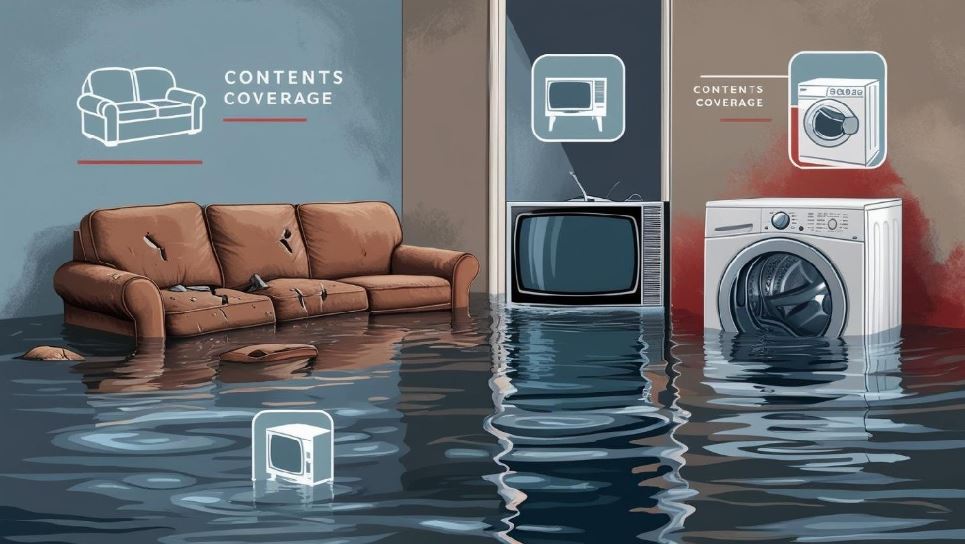
2. Contents Coverage
Contents coverage protects your personal belongings inside the home, including:
- Furniture, clothing, and electronics
- Curtains and portable appliances (e.g., microwaves and air conditioners)
- Washers, dryers, and carpets installed over wood floors
Example: If floodwaters destroy your furniture and electronics, contents coverage reimburses you for their actual cash value (depreciated value).
NFIP vs. Private Flood Insurance
National Flood Insurance Program (NFIP)
The NFIP is federally backed and offers:
- Up to $250,000 in building coverage
- Up to $100,000 in contents coverage
NFIP policies are standardized but may have limitations:
- Contents are covered at actual cash value (not replacement cost).
- Coverage limits may not be sufficient for high-value homes or belongings.
- A 30-day waiting period applies before coverage begins.
Private Flood Insurance
Private insurers offer more flexible options:
- Higher coverage limits (up to millions for buildings and contents)
- Replacement cost coverage for personal belongings
- Shorter waiting periods (as little as 10 days)
How Much Coverage Do You Need?
Recommendations Based on Your Needs:
1. For Homeowners in High-Risk Areas:
Consider both building and contents coverage to protect against catastrophic
losses.
- Example: $250,000 building + $100,000 contents through NFIP or higher
limits with private insurance.
2. For Homeowners in Moderate-to-Low Risk Areas:
Even outside high-risk zones, flooding can occur. Private flood insurance offers
flexible options for broader protection.
3. For Renters:
Renters should consider contents-only policies to protect personal belongings
since landlords policies don’t cover tenants property.
Why Choose Us?
With so many options available from both NFIP and private insurers, finding the right flood insurance can be overwhelming.
That’s where we come in:
- We compare quotes from multiple providers to find the best coverage at
competitive rates. - Our licensed agents provide personalized advice based on your home’s location
and risk level. - As a virtual agency, we save you time and money—no broker fees when you buy online!

Protect your home and belongings with tailored flood insurance solutions.
FAQS
Yes, in most cases flood insurance does cover storm surge. Storm surge from hurricanes or tropical storms is treated as a type of flooding, because it involves rising water that comes from outside your home and flows over normally dry land. Standard homeowners insurance does not cover this kind of damage, which is why a separate flood insurance policy is so important.
If storm surge causes floodwater to enter your home and damage your walls, floors, built ins or personal belongings, a flood insurance policy can help pay for repairs and replacement, up to your policy limits. Keep in mind that coverage is subject to deductibles and specific policy terms. It will not pay for every type of loss, especially if the damage is from wind only and not from flooding.
Savon Insurance Brokerage can help you understand how your homeowners and flood insurance work together during a hurricane or coastal storm, so you know which policy responds to wind damage and which responds to flood and storm surge.
Flood insurance rates can and do change over time. Rates may increase for several reasons:
- New flood maps or updated flood zone designations
- Changes in your property’s elevation or flood risk data
- Updates to national flood insurance rating methods
- Rising costs of construction and rebuilding
- A history of repeated flood losses at the property
In recent years, many properties have seen changes in how flood risk is measured, which can cause some premiums to go up and others to go down. Even if you have not had a claim, your rate can change when the risk model or map for your area is updated.
Working with Savon Insurance Brokerage, you can review your current flood insurance premium, see whether any discounts or mitigation measures are available, and understand how future changes might affect your rate.
You need flood insurance because standard homeowners insurance does not cover flood damage. Flooding is one of the most common and costly natural disasters, and it does not only affect homes in obvious high risk coastal areas. Heavy rain, snowmelt, overflowing rivers, clogged drainage systems, and storm surge can cause serious flood damage in many neighborhoods.
Just a few inches of water in your home can cause thousands of dollars in damage to flooring, walls, appliances, and personal belongings. Without a flood insurance policy, you would have to pay for those repairs out of pocket. Federal disaster aid, if available at all, is often a loan that must be repaid, not a full replacement of what you lost.
Flood insurance gives you a defined safety net. It helps pay to repair or rebuild the structure of your home and replace covered contents after a flood, subject to your policy limits and deductibles. Savon can help you decide whether flood insurance makes sense for your address, even if your lender does not require it.
Flood insurance can feel expensive because floods are high cost events and often affect many homes at the same time. When an area floods, losses are usually large. Water can damage drywall, insulation, electrical systems, flooring, furniture, and major systems like heating and air conditioning. In some cases, homes need to be gutted or rebuilt.
Several factors drive flood insurance cost:
- The flood risk at your specific location
- Your flood zone and how close you are to water
- The elevation of your building compared to base flood level
- The age and construction of the home
- The coverage limits and deductibles you choose
- Whether the structure has had previous flood losses
In higher risk zones or low lying coastal areas, the chance of a serious flood is much greater, so premiums reflect that. The goal of flood insurance pricing is to match the premium to the actual risk of loss for each property. Savon Insurance Brokerage can help you explore coverage and deductibles that fit both your budget and your risk tolerance.
Flood insurance is separate from standard homeowners insurance because flooding is considered a catastrophic risk that is different from fire, theft, or simple water leaks. When floods occur, they often impact entire neighborhoods or communities at once, creating very large losses that are difficult for regular homeowners policies to absorb.
For many homes, flood insurance is offered through a specific flood program or flood policy form rather than as part of the standard home policy. This separation allows:
- Better tracking of flood risk and flood claims
- Separate pricing for buildings in different flood zones
- Clearer rules about what flood events are covered
Because most homeowners policies exclude flood, you need a separate flood insurance policy if you want protection from rising water that comes from outside your home. Savon can help you add flood insurance alongside your home insurance so there are no gaps.
Usually, the property owner pays for flood insurance. If you own the home and there is a mortgage, your lender may require you to carry flood insurance if your property is in a high risk flood zone. In that case, you choose the policy and pay the premium, either directly or through your escrow account.
If you are a renter, you can buy a separate flood insurance policy that covers your personal belongings inside the rental property. Your landlord’s flood insurance, if they carry it, typically covers the structure, not your clothes, furniture, and electronics.
Sometimes, housing associations or condo associations purchase flood insurance on the building and common areas. Individual unit owners may still need their own flood policy to protect unit interiors and contents. Savon Insurance Brokerage can help you figure out who is responsible for which part of the property and make sure you have the right flood coverage for your role as owner, landlord, association, or tenant.
More people should consider flood insurance than just those in obvious coastal flood zones. You should seriously consider flood insurance if:
- Your home is in a high risk flood zone designated by your lender or flood maps
- Your mortgage company requires it
- You live near rivers, lakes, streams, or drainage channels
- Your area has a history of flash flooding or heavy rainfall
- You live in a low lying or poorly drained neighborhood
- You would struggle to pay for major repairs out of pocket after a flood
Even in moderate or low risk zones, flooding can still happen. Many flood claims occur outside of the highest risk areas. Flood insurance is one of the few ways to protect your home and belongings from rising water. Savon can use your address and property details to help you decide if flood insurance is a smart layer of protection for you.
Flood insurance is available from two main sources:
- National or government backed flood programs
Many properties are insured through nationally supported flood insurance programs that follow set rules and coverage forms. These policies are often sold and serviced by local agents and brokers, including Savon Insurance Brokerage. - Private flood insurance companies
In some areas, private insurers offer their own flood insurance policies with different coverage options, limits, and pricing. Private flood insurance can sometimes provide higher limits or more flexible coverage than standard program policies.
Savon works with multiple flood insurance options where available. We can help you compare standard program coverage with private flood insurance offerings so you can choose the one that fits your property, your lender’s requirements, and your budget.
A church is usually insured under a commercial or non residential flood insurance policy, not a standard residential policy. The policy type depends on:
- How the building is used (worship, offices, community events)
- How the property is titled and owned
- Whether there are additional buildings, such as halls or schools, on the premises
Commercial flood insurance policies are designed to cover buildings that are owned by organizations, businesses, or non profits, including churches. They typically provide separate limits for the structure and for contents such as pews, sound systems, office equipment, and furnishings.
Savon Insurance Brokerage can help a church or religious organization choose the right flood insurance policy, coordinate it with the property and liability insurance, and make sure that all buildings and contents on the campus are properly listed and covered.
Several types of insurers and programs offer flood insurance:
- Carriers that participate in national or government backed flood programs
- Private insurance companies that sell stand alone flood policies
- Specialty carriers that focus on coastal or high risk flood regions
Some homeowners insurance companies also act as servicing carriers for flood insurance, meaning they issue and manage flood policies on behalf of the national flood program. Private flood insurers may offer their own flood forms that differ from standard program coverage.
Because the list of companies that offer flood insurance changes over time and varies by state, it is much easier to work with a broker like Savon. We know which insurance companies currently write flood insurance in your area, what coverage options they offer, and how their pricing compares.
Flood zones are used to describe levels of flood risk. In general, lenders require flood insurance for buildings located in certain zones that are considered high risk. These are often labeled as:
- Zones that start with letters such as A or V on flood maps, indicating high risk flood areas
- Special flood hazard areas, where the chance of flooding in any given year is higher than in moderate or low risk zones
If your property is in a designated high risk flood zone and you have a mortgage from a federally regulated or insured lender, you are typically required to carry flood insurance. Even in moderate or low risk zones, flood insurance is still available and often recommended, but not always required.
Savon can help you look up your flood zone, explain what it means, and tell you whether your lender is likely to require flood insurance based on that designation.
Flood insurance is usually required:
- When a property is located in a high risk flood zone, as shown on official flood maps
- When the property is financed by a federally regulated or insured lender
- When federal or local regulations tied to disaster assistance or rebuilding require it
In these situations, lenders insist on flood insurance to protect their interest in the property. They want to make sure that if a serious flood occurs, there will be funds available to repair or rebuild the building, rather than leaving both the homeowner and the lender exposed to large losses.
Even if you do not have a mortgage, flood insurance may still be a wise choice. Many homes in moderate or low risk zones have experienced unexpected flooding, especially with changing weather patterns. Savon can tell you whether flood insurance is required for your home today and whether it is recommended based on your specific risk.
You can get flood insurance:
- Through an independent brokerage like Savon Insurance Brokerage, which can access both national program coverage and private flood insurance where available
- Directly from some insurance companies that participate in flood insurance programs
- Through agents who represent specific carriers or local agencies
Because flood insurance has its own rules and coverage terms, it helps to work with someone who understands how it fits with your homeowners policy. At Savon, we can:
- Explain your flood risk
- Help you pick appropriate building and contents limits
- Compare standard and private flood insurance options
- Coordinate effective dates so you are not caught by waiting periods
You do not need to guess which company offers flood insurance in your area. We can do that legwork for you.
Flood insurance is typically required:
- When a building is in a high risk flood zone identified on official flood maps
- When that building is financed by a federally regulated or insured lender or certain other mortgage holders
- When government backed loans or grants for rebuilding require it as a condition of assistance
In these cases, your lender will tell you that flood insurance is mandatory as a condition of closing or keeping the loan. If you drop the coverage, the lender may purchase flood insurance on your behalf and add the cost to your mortgage, which is often more expensive and less flexible.
Savon can help you meet these flood insurance requirements in a way that still lets you choose your carrier, coverage limits, and deductible, instead of having coverage forced on you by the lender.
The best time to buy flood insurance is before you need it. There is usually a waiting period between the time you purchase a flood policy and the date coverage starts. This waiting period is often around 30 days for many flood programs, with some exceptions for new loan closings or map changes.
That means you cannot wait until a storm is in the forecast or a river is already rising to add flood coverage and expect immediate protection. If you are thinking about flood insurance:
- Buy it well before hurricane season, heavy rainy periods, or snowmelt
- Make it part of your home purchase or refinance process
- Review it regularly when you update your homeowners policy
Savon can help you time your flood insurance purchase so you are not caught in the waiting period while a storm approaches.
Flood insurance is mandatory when:
- Your property lies in a designated high risk flood zone according to official flood maps
- You have a mortgage from a lender that is bound by federal or similar flood insurance regulations
- Certain rebuilding or assistance programs require you to maintain flood coverage going forward
In these situations, you do not have a choice if you want the mortgage or assistance. You must carry flood insurance for at least the amount required by the lender or program, which may be the outstanding loan balance or a set coverage limit.
Even if flood insurance is not legally mandatory for your property, it might be personally essential if a flood would create a financial hardship for you. Savon can help you understand both the official flood insurance rules and what makes sense for your family’s financial safety net.
Flood insurance is specific in what it does not cover. Common exclusions include:
- Damage from moisture, mildew, or mold that could have been avoided by the property owner
- Damage from sewer backup or sump pump failure, unless it is directly caused by a flood and policy conditions are met
- Property outside the insured building, such as fences, decks, patios, walkways, and many landscaping features
- Most currency, precious metals, and valuable papers
- Additional living expenses or temporary housing under some standard flood policies, unless you have a policy that includes that coverage
- Damage that is not directly caused by flood, such as wind only damage that should be covered by homeowners insurance instead
Flood policies also have limits and caps on certain items and areas, such as basements and below ground areas. Savon Insurance Brokerage will walk you through what your flood policy excludes so that you understand where you may need to rely on savings, homeowners insurance, or other solutions.
Flood insurance is designed to cover direct physical loss to your property caused by a flood, which generally means an excess of water on land that is normally dry. Flood policies typically offer:
- Building coverage:
This helps pay to repair or rebuild the structure of your home or building, including foundation, walls, flooring, built in cabinets, electrical and plumbing systems, central air and heating, and certain permanently installed fixtures. - Contents coverage:
This helps pay to replace covered personal belongings such as furniture, clothing, electronics, appliances, and certain valuables that are damaged by a flood, up to the contents limit you choose.
Coverage is subject to policy limits, deductibles, and exclusions, and there are special rules for basements and below ground locations. Flood insurance focuses on damage from rising water that comes from outside the home and flows over normally dry land. It does not cover every type of water damage, such as simple leaks or burst pipes, which are usually addressed by homeowners insurance instead.
Savon can help you choose building and contents limits that match your home, your belongings, and your budget so you are not underinsured or overinsured.
Flood insurance works like other property insurance in some ways, but it follows flood specific rules. Here is the basic process:
- You purchase a flood policy with selected building and contents limits and deductibles. A waiting period usually applies before coverage starts.
- A flood event occurs that brings rising water into your home or building and causes damage.
- You report a claim to the insurance company or through Savon as your broker. You share details about the flood, take photos, and document damaged items.
- An adjuster investigates to confirm that the loss meets the definition of a covered flood and to estimate the cost to repair or replace building elements and contents.
- The insurer reviews coverage, applies deductibles and limits, and issues payment for the covered damage. You use these funds to repair, rebuild, and replace items.
Flood insurance is not a guarantee of full restoration for every item. It is a financial tool that helps you recover from a flood by sharing the cost with the insurer. The more accurately your coverage limits are set before a flood, the more effective that tool will be. Savon’s role is to help you set up the right flood coverage and support you if you ever need to file a claim.
Flood insurance cost is calculated based on several factors. Common rating elements include:
- The flood risk at your location and your flood zone designation
- The elevation of your building compared to base flood level
- The type, size, and age of your home or building
- The construction type and foundation (slab, crawlspace, basement, elevated, and so on)
- Whether there has been prior flood damage or claims
- The coverage limits and deductibles you select for building and contents
Modern flood rating methods look more directly at property specific risk factors like distance to water, ground elevation, and replacement cost. This allows premiums to better reflect the true flood risk of each building.
Savon can take your address and property details, request quotes from available flood insurance programs and private insurers, and explain how your rate was calculated so you understand why it costs what it does.
Flood insurance cost varies widely from one property to another. Some low or moderate risk homes might have relatively modest premiums, while high risk coastal or riverfront properties can have much higher costs. The price is mainly driven by:
- Your flood zone and risk level
- Elevation and proximity to water
- Coverage limits selected for the building and contents
- Deductible amounts
- Building characteristics and prior flood history
National averages can give a very rough idea, but they do not tell you what your flood insurance will cost. The only reliable way to find out is to get a quote based on your specific property data.
Savon Insurance Brokerage can gather this information once and bring you real flood insurance quotes from applicable programs and companies. We will show you how changing limits and deductibles changes the price, so you can decide what level of protection fits your budget.
The amount of flood insurance you need depends on:
- The replacement cost of your home or building
- The amount of your mortgage and lender requirements
- The value of your personal belongings
- Your financial ability to absorb part of a loss out of pocket
For building coverage, many owners aim for a limit that is close to the full replacement cost of the structure, or at least high enough to satisfy the lender and cover major rebuilding needs. For contents coverage, you should think about how much it would cost to replace your furniture, clothing, electronics, and other household items if they were destroyed by a flood.
You can also adjust deductibles to balance affordability and protection. A higher deductible usually means a lower premium, but you must be comfortable paying that amount yourself if a flood occurs.
Savon can help you estimate appropriate building and contents limits by looking at your home’s features, comparable rebuilding costs, and your personal situation.
Flood insurance can sometimes be waived by a lender, but only under specific circumstances. For example:
- If updated flood maps show that your property is no longer in a high risk flood zone
- If you provide documentation, such as an elevation certificate or a letter of map amendment, showing that your building is above the required flood elevation
In these cases, a lender might decide that flood insurance is no longer required as part of the mortgage. However, this does not mean that flood risk is zero. Flooding can still occur in moderate or low risk zones, and you can usually continue flood insurance voluntarily even if the lender does not require it.
If you are considering a lender waiver, talk with Savon first. We can help you understand the pros and cons, the real flood risk for your address, and what it would mean to drop coverage versus keeping it.
In many cases, flood insurance premiums can be paid in different ways depending on the program and the company. Some arrangements require an annual premium up front, especially when the policy is first issued. In other cases, you may have the option to:
- Pay flood insurance through your mortgage escrow, which is effectively a monthly payment into escrow
- Use certain payment plans offered by private flood insurers or agencies, where allowed
When flood insurance is tied to a mortgage escrow account, you pay into the escrow each month along with principal, interest, and property taxes. The lender then pays the flood premium in full when it is due.
Savon can explain which payment options are available for the specific flood insurance policy you choose and help you set up a plan that fits your cash flow.
Yes, flood insurance is often escrowed as part of your monthly mortgage payment. When a lender requires flood insurance, they typically:
- Include an estimated flood premium amount in your escrow calculation
- Collect a portion of that cost each month along with your mortgage payment
- Use the escrow funds to pay the full annual flood insurance premium when it is due
Escrowing flood insurance can make payments more manageable and ensures that coverage does not lapse due to missed bills. If you own your home free and clear, you can still choose to pay flood insurance annually or explore any available payment options, but there will be no escrow unless you set one up with a service.
Savon Insurance Brokerage can coordinate directly with your lender or mortgage company to make sure the flood policy is properly listed and that escrow billing is set up correctly.
Many flood insurance premiums under national flood programs follow rating rules and guidelines that are set or overseen at the federal level. These rating systems look at factors like flood risk, building characteristics, elevation, and coverage limits. The goal is to make pricing more consistent and more closely aligned with true flood risk.
However, not all flood insurance comes from federal programs. Private flood insurance companies can set their own rates using their own models, subject to state insurance regulations. Their premiums may be higher or lower than program rates depending on how they view the risk.
Savon works with both program based and private flood insurance options where available. We can show you how premiums differ and explain which parts of pricing are driven by national rules and which parts are set by individual insurers.
In some cases, flood insurance policies can be transferred or assumed by a new owner when a property is sold, especially if the policy is written through a national flood insurance program and the rules allow it. This can be helpful because:
- The buyer may benefit from an existing policy and its rating
- The transfer can help avoid gaps in coverage during the sale
Not every situation allows an easy transfer. Private flood insurance policies may have their own rules about whether a policy can be transferred or if a new policy must be issued for the buyer.
If you are selling or buying a home in a flood zone, it is important to address flood insurance early in the process. Savon can work with both parties to determine whether the existing flood policy can be transferred or whether a new policy is needed, and then help set up whatever is required for closing.
In general, flood insurance proceeds that pay for physical damage to your home or personal property are not taxable as ordinary income. They are usually treated as compensation for a loss rather than earnings. For example, if your policy pays to repair your house or replace damaged furniture after a flood, that payment is typically not subject to income tax.
However, there can be situations where tax questions arise, such as:
- If you receive more money than your adjusted basis in the property and do not reinvest
- If payments are connected to rental income or business use of the property
- If you previously claimed a casualty loss deduction for the same event and later receive reimbursement
Because tax treatment depends on your personal financial situation and current tax law, you should always consult a qualified tax professional about how to report any large flood insurance payment. Savon Insurance Brokerage can explain the insurance side of your claim, while your accountant or tax advisor can explain what it means for your tax return.